Pages

Showing posts with label Science 2018. Show all posts

Wednesday, 7 November 2018

Making a glowing moon!!


Aim: I want to make a glowing moon in science.

Related image
Glowing Moon

Equipment:

  • Balloon
  • Paper mache/towels
  • Glue
  • Fairy lights/lamp
  • Paint
  • Sponge
Method:

  1. Blow up the balloon.
  2. Draw a small/medium circle around the end of the balloon.
  3. Mix 1 part water and 1 part glue together in a bowl.
  4. Cut your paper towels up into strips.
  5. Dip the paper into the water glue solution and cover the entire balloon with the paper mache. (make sure to not cover the circle that you drew)
  6. Let dry.
  7. Repeat until the balloon is sturdy. (2/3 times)
  8. With the sponge paint the balloon into a moon-like colour.
  9. Pop the balloon and where you kept the circle put your fairy lights or lamp into the hole.
  10. Turns the lights on and go into a dark room.
Youtube Clip

Results:


Thursday, 6 September 2018

What Happens To Food?


Ingestion:
  • When food enters your mouth its called ingesting food.
  • Chewing food is called Mastication. 
  • Swallow food.
  • The teeth that you chew food with is called a molar.
  • The teeth that you rip and tear food with is called canines. 
  • The teeth that you cut food with is called the incisors.
  • Our Salivary glands add saliva to the food to help lubricate it.
Image result for eating food
Image result for eating food gif
  • The food is "pushed" down the esophagus to the stomach by waves of muscle contractions. Circular muscles contract behind the bolus pushing it downwards. Longitudinal muscles contract, widening and the diameter and shortening the length of the tube. This process is called peristalsis.
Related image 
Image result for peristalsis gif

Digestion:

Stomach:

The esophagus leads to the stomach.
The stomach can hold 2-4 litres of fluid.
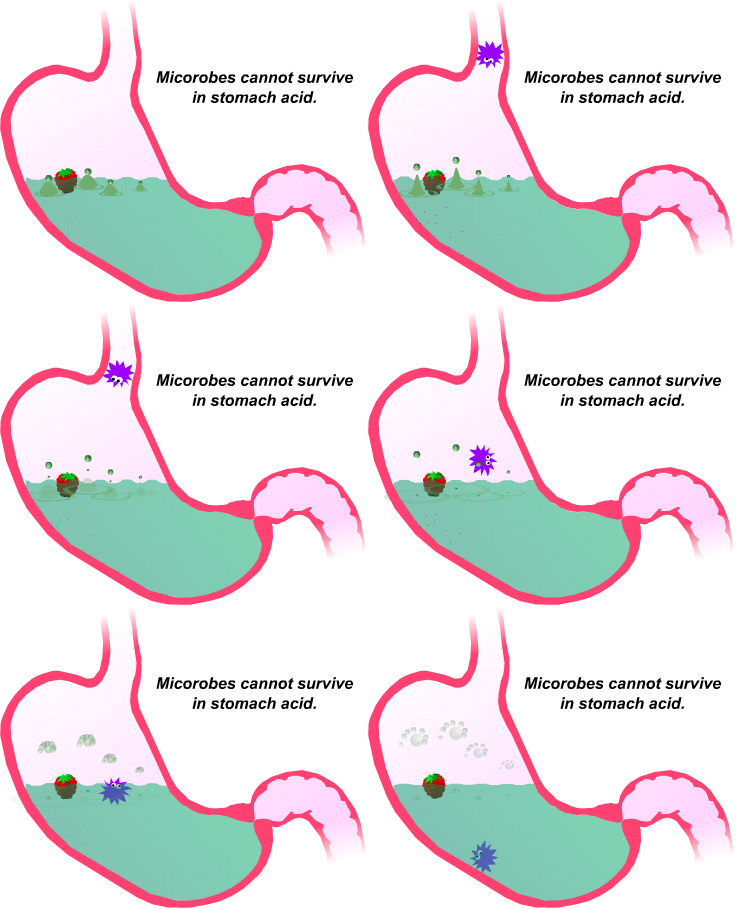
It holds acid which digests food.
The stomach is a large elastic bag that can expand to hold many litres of food.
The PH of the acid is 1-2
The interior of the stomach is lined with holes called gastric pits.
Related image

Small Intestine: 

The small intestine lies between the stomach and the large intestine.
The PH is between 7-9.
Absorption of nutrients takes place in the small intestine.
The inner walls are covered in small, finger-like projections called villi.
The projections increase the surface area of the small intestine, which increases the rate of absorption.

Image result for small intestine
https://www.vectorstock.com/royalty-free-vector/cartoon-of-large-and-small-intestine-vector-7523894

Large Intestine:

Reabsorption of ions and water is a vital function of the large intestine.
The inner surfaces do not contain villi.


Liver:


The liver is the second largest organ in the human body.
A green coloured fluid called bile is produced in the liver.
Average mass of the human liver is about 1.5kg.
The liver detoxifies chemicals and metabolizes drugs.
The liver makes proteins important for blood plasma and other functions.

Image result for liver gif
https://makeagif.com/gif/what-is-cirrhosis-of-the-liver-3d-medicalshow-animation-LkSGJJ


Absorption:


Egestion:


Thursday, 9 August 2018

Food Testing

Testing for simple sugars

Aim:
I want to find out how to test for simple sugars.

Equipment:

  • Bunsen burner
  • Test tube tongs
  • Benedicts Solution
  • Food sample
  • Test tubes
  • Safety Glasses
Method:
  1. Place about 2mL of food sample into a test tube then add 5 drops of Benedict's solution.
  2. Heat the test tube over a blue flame. (DO NOT LET BOIL!!!)
Results:
A positive test for a simple sugar result in the Benedict's Solution changing from a blue colour to an orange colour to a red/brown colour.

Conclusion:
The orange juice reacted with Benedict's Solution, therefor orange juice must contain simple sugar.

Photos:


Testing for Complex Sugars (Iodine Test)

Aim:
I want to find out how to test for complex sugars

Equipment:
  • Iodine solution
  • Food sample
  • Test tube
Method:
  1. Place 2mL of the food sample into a test tube.
  2. Add 3-5 drops of iodine
Results
If complex sugars are present, the iodine solution will change from a brown colour to a black colour.

Conclusion
Bread reacted with the iodine solution, therefore bread contains complex sugar.

Testing for Protein (Biuret Test)

Aim:
I want to find out how to test for protein.

Equipment:

  • Test tube
  • Food Sample
  • Sodium Hydroxide
  • Copper Sulfate
Method:
  1. Put the food sample into the test tube.
  2. Add 5 drops of Sodium Hydroxide into the test tube.
  3. Add 5 drops of Copper Sulfate into the test tube.
  4. Gently shake from side to side
Results:
If the solution remains blue, then no protein is present. If the solution turns to a purple colour, then protein is present.

Conclusion:
The solution turned purple so therefor egg does contain protein.


Photos:


Monday, 6 August 2018

Animal Kingdom Part 2


True Worms:
Body is tubular and/or made up of segments
Tube-like digestive system
Image result for rag worm
Ragworm

Image result for earthworms
Earthworm

Flat worm:
Breathe through their skin
Unsegmented Body


Image result for flukes
Fluke

Image result for tapeworm
Tapeworm
Sponges:
Takes in water through pres (little holes) 
in their bodies from which they 
filter (take out) little bits of food

Image result for demosponge
Demosponge

Image result for hexactinellida
Hexactinellid
Cnidarians
Hollow body with specialised
cells (stingers) that they use for
capturing prey
Live in water


Image result for sea anemone
Sea anemone
Image result for jellyfish
Jellyfish
Molluscs
Most live in the sea 
Most have shells
Unsegmented body


Image result for sea slug
Sea slug
Image result for shellfish
Shellfish

Echinoderms
A skeleton made up of five plates
Tube feet
Live in the sea
Jointed legs
Divided into four further sub-groups


Image result for sea urchin
Sea urchin
Image result for starfish
Starfish
Arthropods

Crustaceans
Most are aquatic 
Body Divided into three parts
Most breathe with gills
Hard outer skeleton

Image result for crab
Crab

Image result for krill
Krill

Image result for copepods
Copepod

Myriapods
Many pairs of legs
A single pair of antennae
Simple eyes


Image result for centipede
Centipede

Image result for millipede
Millipede

Insects
Body divided into three parts
Three pairs of legs and two pair of wings
One pair of antennae on head
Compound eyes

Image result for bee
Bee

Image result for butterfly
Butterfly

Image result for ladybug beetle
Ladybug bettle
Arachnids
Body divided into two parts
Four pairs of legs and no wings
No antennae


Image result for spider
Spider

Image result for scorpion
Scorpion
Image result for schizomida
Schizmodia